
The Pentagon’s reconciliation ask is a request; the only ceiling either chamber has written is $60 billion over ten years, and neither is law. The drone money you can bid on this year already has three offices attached.
At 11:00 a.m. on Thursday, October 15, Rep. Robert J. Wittman of Virginia was designated Speaker pro tempore. The chaplain prayed, the Journal was approved, the Pledge was recited, and at 11:04:23 the House adjourned. On Tuesday it had met for three minutes and 45 seconds. The Senate met on both days and conducted no business either time.
On the Wednesday between, Secretary of War Pete Hegseth spoke on an AUSA panel on autonomous warfare. The Department, he said, would make sure a reconciliation bill came in “at a minimum of 350, potentially more.” He left the unit off. The $50 billion for autonomy that he placed inside the same bill supplies it.
The only fiscal 2027 budget resolution either chamber has adopted allows the House Armed Services Committee to add up to $60 billion to the deficit over ten years. Neither number is law. The drone money a small firm can compete for this year is the money the Department already spends, $1.9 billion of it in fiscal 2025, the last complete year on record, and three offices did most of that buying.
I carried the Pentagon acquisition office’s accounts to Capitol Hill. A number said in public was where that work began, never where it ended.
Five companies, more than four-fifths of the drone money. In fiscal 2025 the Department obligated $1.86 billion on contracts for unmanned aircraft. Five companies took 85 percent of it, and three contracting offices awarded 73.6 percent.
The Secretary’s $50 billion for autonomy is more than twenty times that. Until it is law, the $1.9 billion is the money a small firm can bid on. Its doors have names: Naval Air Systems Command, Army Contracting Command at Redstone Arsenal, and the Air Force’s unmanned aircraft division. DIA analysis of federal contract records, product code 1550. Contracts only; research, counter-drone systems, parts bought under other codes and Other Transaction agreements are not counted, so this is a floor.
Three Numbers, Three Instruments
Each figure in this issue is a different instrument, and only one of them pays anyone. The Secretary’s 350 is a request. A request is a sentence until Congress writes it down.
H.Con.Res. 113 is what the House has written down. The House agreed to it on July 22, 216–214. It is a budget resolution, an instruction Congress gives its own committees, and it moves no money. Section 201 tells Armed Services to submit changes in law that “increase the deficit by not more than $60,000,000,000 for the period of fiscal years 2027 through 2036,” due by September 11. That averages $6 billion a year. Call it the ceiling.
The ceiling binds nobody yet. The Senate has not voted on a fiscal 2027 budget resolution. Budget Committee Chairman Ron Johnson has introduced one; Jeff Merkley is the committee’s ranking member. “There’s about $50 billion in autonomous and robotic system in the reconciliation bill,” the Secretary said. No reconciliation bill for fiscal 2027 has come to a vote in either chamber.
The money that is law is the stopgap. P.L. 119-103, approved September 2, holds the Department at fiscal 2026 rates through December 11. Section 102 bars that money from any “project, activity, operation, or organization” that had no fiscal 2026 funds. Call it the freeze. AutoWARCOM, one of three places the $50 billion would go, is to be “a four star combatant command with service like authorities,” in the Secretary’s words. On our reading of the freeze, a new command waits for a full-year bill, an exception written into a stopgap, or reconciliation.
The Objection: This Congress Can Move Fast
The strongest objection is that this Congress has moved reconciliation quickly before. The House agreed to the fiscal 2026 budget resolution on April 29, and the reconciliation bill written under it, S. 2, passed the Senate on June 5 and the House on June 9. That took forty-one days. A firm that shrugs at the 350 could miss the largest drone money it will ever see.
The objection changes the timing, not the plan. Reconciliation money still reaches a small firm through a contracting office that signs an award. The Secretary named new homes for it, and when one of them buys, its office will appear in the record like any other. Until then, the money with an office attached is the $1.9 billion.
A request is a sentence until Congress writes it down.
The Secretary also wants more contractors. “Our job,” he said, “is to open the aperture up to these incredible new companies.” In unmanned aircraft it is already open a crack. In fiscal 2025, about 38 firms with no unmanned-aircraft contract money in the previous four years took about $22 million, 1.2 percent of the total. Set-asides were not how most of them got in: more than three-quarters of that money came without one. Across the whole market, set-asides carried 1.2 percent, counting orders placed on set-aside contracts. In this market the door is a named office or a large firm’s supply chain.

The Board
The middle column is what the record shows. The last column is the next thing you can observe.
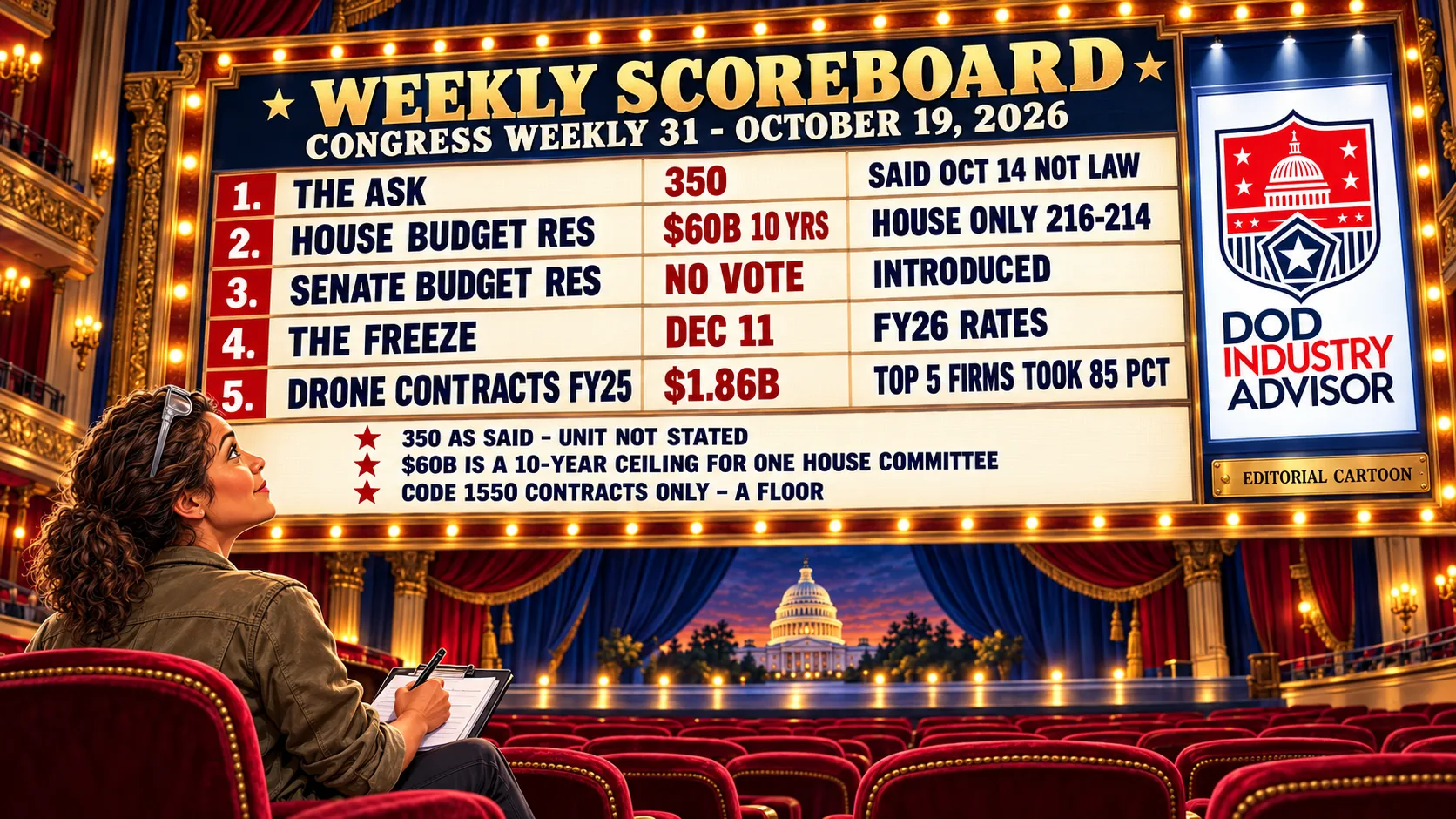
| Item | What the record establishes | What to watch next |
|---|---|---|
| The ask | October 14, AUSA: Secretary Hegseth wants a reconciliation bill “at a minimum of 350, potentially more,” with “about $50 billion” for autonomy. A request, not law. | Reconciliation text published by a committee |
| House budget resolution | H.Con.Res. 113, agreed July 22, 216–214. The Armed Services ceiling is $60 billion over fiscal 2027–2036. | The Armed Services Committee’s recommendations under the ceiling |
| Senate budget resolution | No Senate vote on a fiscal 2027 resolution. Chairman Johnson has introduced one. | A Budget Committee markup or a floor vote |
| The freeze | P.L. 119-103 holds fiscal 2026 rates through December 11 and bars money for anything that had no fiscal 2026 funds. | Full-year bills or a second stopgap |
| House | No recorded vote since September 16 (Roll 314). Pro forma sessions October 13 (3 min 45 s) and October 15 (4 min 23 s). | Pro forma sessions scheduled October 19 and 22 |
| Senate | Last roll call September 30 (vote 256). Pro forma sessions October 13 and 15; no business conducted. | Business scheduled to resume November 9, with a cloture vote on the motion to proceed to H.R. 2347 at about 5:30 p.m. |
The Senate is not scheduled to do business before the election on November 3. It is scheduled to return to business on November 9.
| Sun | Mon | Tue | Wed | Thu | Fri | Sat |
|---|---|---|---|---|---|---|
| Oct 11 | 12 | 13pro forma · both | 14the ask, at AUSA | 15pro forma · both | 16 | 17 |
| 18 | 19today · pro forma sched. · both | 20 | 21 | 22pro forma sched. · both | 23 | 24 |
| 25 | 26Senate pro forma sched. | 27 | 28 | 29Senate pro forma sched. | 30 | 31 |
| Nov 1 | 2Senate pro forma sched. | 3Election Day | 4 | 5Senate pro forma sched. | 6 | 7 |
| 8 | 9Senate sched. · 5:30 cloture vote | 10 | 11 | 12 | 13 | 14 |
Outlined = one chamber only. Blank = out; “pro forma” = opened and closed with no business. Past days from the House and Senate floor records; days marked “sched.” are schedule, not record. House days after October 22 and Senate days after November 9 were not re-checked this week and are left blank.
Playbook: Read the Bottom of a Concentrated Market
A concentrated market is not a closed one. Five firms took more than four-fifths of fiscal 2025’s unmanned-aircraft money. About 67 others shared the rest, and the typical firm took about $207,000.
The smallest awards are the map
Every contract record names the buyer, the seller, and, in a description field, what was bought. In a market led by five large firms, the useful records sit at the bottom of the list. The smallest awards show which offices buy from firms that are not the five, and what they bought.
Consider a hypothetical nine-person firm that builds launch and recovery gear for small drones. It has been waiting on the reconciliation money. It pulls fiscal 2025 awards for unmanned aircraft and reads the dozens under $1 million. Six are for something close to its product, and two offices made four of those six awards. Those two offices are its pipeline, whatever Congress does in November.
Pull fiscal 2025 awards for product code 1550, or for your own code, on USAspending. Sort the recipients by dollars and read the bottom twenty: the awarding office and the description of each. Mark every award that resembles what you sell. Then check whether the office that made it has an open notice on SAM.gov this week.
The Final Whistle
This week, on Monday and Thursday at 9:00 a.m., the Senate is scheduled to gavel in again, with no business expected. A session without business cannot change the law, and the law today is the freeze. The 350 was said. The $1.9 billion was signed.
Which money is your drone or autonomy pipeline waiting on?
A) Awards already on contract
B) Full-year fiscal 2027 appropriations
C) Reconciliation
D) I have not sorted it that way
E) No drone or autonomy work in my pipeline
Reply with your letter and one line on why. The most useful answer runs next week, anonymous if you prefer.
How I Help Small Defense Businesses
Through DoD Industry Advisor I help small defense businesses turn market information into a pursuit decision. The work covers the buyer, the funding signals, the incumbent, the timing, the gaps in your position, and what to do next. Bring one opportunity you are weighing and the decision you need to make. Request a 30-minute fit call; we scope the work in writing before it starts. What DIA does.
Sources checked
CONFIRMED
- House floor, October 13 and 15: Tue., Oct. 13: convened 1:30:00 p.m., adjourned 1:33:45 p.m. (3 min 45 s); Rep. James R. Baird designated Speaker pro tempore. Thu., Oct. 15: convened 11:00:00 a.m.; Rep. Robert J. Wittman designated Speaker pro tempore; prayer by the House Chaplain, Journal approved, Pledge of Allegiance; adjourned 11:04:23 a.m. (4 min 23 s), next meeting 10:00 a.m. Oct. 19. Combined, 8 min 8 s. No floor record for Oct. 12, 14, 16 or 17. Oct. 19 had no floor record when checked on the morning of Oct. 19. Verified 2026-10-19. Clerk, Oct. 13 · Clerk, Oct. 15
- House recorded votes: Last roll call No. 314, Wed., Sept. 16, 2026; none since (33 days before Oct. 19). Verified 2026-10-19. House Clerk roll calls
- House schedule, this week: Pro forma Mon., Oct. 19, 10:00 a.m. and Thu., Oct. 22, 3:00 p.m.; not in session Oct. 20, 21, 23. Schedule, not record. Verified 2026-10-19. House Republican Cloakroom · Oct. 15 adjournment
- Senate floor: Pro forma Tue., Oct. 13, 3:30 p.m., Sen. Hagerty presiding; Thu., Oct. 15, 9:30 a.m., Sen. Moreno presiding; “no business was conducted” both days. Scheduled: pro forma Oct. 19 and 22 (9:00 a.m.), Oct. 26 (5:30 p.m.), Oct. 29 (2:00 p.m.), Nov. 2 (4:30 p.m.), Nov. 5 (10:30 a.m.); convenes for business Mon., Nov. 9, 3:00 p.m., with a cloture vote on the motion to proceed to H.R. 2347 at about 5:30 p.m. Verified 2026-10-19. Press Gallery, Oct. 13 · Oct. 15 · front page
- Senate recorded votes: Last roll call vote 256, Wed., Sept. 30, 2026 (Sonderling confirmed Secretary of Labor, 47–41); none since. No vote on a fiscal 2027 budget resolution on the 2026 vote menu. Verified 2026-10-19. Senate roll calls
- The ask: Transcript, “Secretary of War Pete Hegseth and Service Secretaries Speak on Autonomous Warfare at AUSA,” Oct. 14, 2026. Verbatim: “whether it’s 350 is a minimum of a reconciliation bill or more”; “there’s about $50 billion in autonomous and robotic system in the reconciliation bill that would go into DAWG, into Project Agincourt and into AutoWARCOM”; “that reconciliation bill at a minimum of 350, potentially more”; “a four star combatant command with service like authorities in AutoWARCOM”; “our job is to open the aperture up to these incredible new companies.” war.gov returns 403 to this server; read from the Internet Archive copy fetched 2026-10-19 (the Archive was offline at drafting; the quotations were re-read from that fetched copy). Verified 2026-10-19. war.gov transcript
- H.Con.Res. 113: Fiscal 2027 budget resolution, agreed to by the House Wed., July 22, 2026, 216–214 (Roll 281). Sec. 201(b)(2): Armed Services “shall submit changes in laws within its jurisdiction that increase the deficit by not more than $60,000,000,000 for the period of fiscal years 2027 through 2036,” submissions due “not later than September 11, 2026.” $60 billion over ten years averages $6 billion a year. Verified 2026-10-19. engrossed text · Roll 281
- Senate Budget Committee: Chairman Ron Johnson (R-Wis.), Ranking Member Jeff Merkley (D-Ore.); the committee lists “Chairman Johnson Introduces FY27 Budget Resolution.” Verified 2026-10-19. budget.senate.gov
- No fiscal 2027 reconciliation vote in either chamber: No House passage vote after June 9 is a reconciliation bill (the July 22 vote was the budget resolution); no Senate reconciliation vote after S. 2 on June 5. Verified 2026-10-19. House Clerk · Senate roll calls
- Fiscal 2026 precedent: S.Con.Res. 33 agreed to by the Senate Apr. 23 (50–48) and the House Apr. 29 (215–211). S. 2, “an original bill to provide for reconciliation pursuant to title II of S. Con. Res. 33,” passed the Senate June 5 (52–47) and the House June 9 (Clerk title “Secure America Act”). April 29 to June 9 is 41 days. Verified 2026-10-19. Senate roll calls · House Clerk
- P.L. 119-103 (H.R. 6500): Approved Sept. 2, 2026. Sec. 101 continues fiscal 2026 rates; Sec. 102(a)(3) bars Defense Department use of that money for “the initiation, resumption, or continuation of any project, activity, operation, or organization … for which appropriations, funds, or other authority were not available during fiscal year 2026”; Sec. 104 bars new starts; Sec. 106(3) ends the period Dec. 11, 2026 (a Friday, 53 days after Oct. 19). Verified 2026-10-19. public law text
- Election Day: Tue., Nov. 3, 2026 (2 U.S.C. 7). Verified 2026-10-19. 2 U.S.C. 7
- The Number — unmanned aircraft contracts, fiscal 2025: DIA analysis of USAspending contract transactions awarded or funded by the Department of Defense, product and service code 1550 (unmanned aircraft), fiscal 2025, the latest complete year in DIA’s copy (reloaded Oct. 13, 2026; FY2025 checked month by month against the USAspending API). Net obligations $1.860 billion ($1.863 billion across vendors with positive totals, before $3.2 million of net de-obligations). Vendors are counted as companies (recipient names normalized), not registrations: one company can hold several unique entity identifiers. 72 companies with positive totals; the top five took $1,583.8 million, 85.0 percent: General Atomics Aeronautical Systems $745.7 million, Northrop Grumman Systems $400.5 million (three registrations), Kratos Unmanned Aerial Systems $164.0 million, Leidos $160.1 million, Anduril Industries $113.4 million (two registrations). 70 awarding offices; the top three 73.6 percent of net: Naval Air Systems Command $544.9 million, W6QK ACC-RSA $479.4 million, FA8689 AFLCMC WIIK UAS $344.8 million. Query
cw31_number.py(this issue’s folder), outputnumber.json; re-run independently by the writer on 2026-10-19 with identical results; company totals fromcw31_company_check.py, outputcompany_check.json, matching the second reader’s figures. Verified 2026-10-19. USAspending - New entrants and set-asides, fiscal 2025: Same data, matched by company name, not registration. 38 firms with no positive code-1550 obligations in fiscal 2021–2024 took $22.1 million (1.2 percent of net); the largest is Shield AI, $7.9 million. A 39th “new” name, the Miscellaneous Foreign Awardees placeholder ($1.7 million), is not a firm and is left out. Matched by registration instead, the count was 40 and $117.7 million, because $94.0 million went to a new Anduril registration while Anduril’s other registration already had code-1550 money in fiscal 2024. Of the 38 firms’ $22.1 million, $17.3 million came without a set-aside. Set-asides, market-wide: $22.3 million (1.2 percent of net) was awarded under a small-business set-aside, counting delivery orders whose own set-aside field is blank at the set-aside of the parent contract ($453.4 million of orders carry a blank field); the transaction field alone gives $12.1 million (0.65 percent). The set-aside field, not the awardee’s size. Verified 2026-10-19. USAspending
- The typical vendor, fiscal 2025: Same data, net obligations summed by company: median $207,216 across the 72 companies with positive totals; 44 of the 72 under $1 million. The five largest and 67 others make 72. Query
cw31_company_check.py, run by the writer 2026-10-19. Verified 2026-10-19. USAspending - Scale: $50 billion ÷ $1.86 billion = 26.9; the text says “more than twenty times.” Verified 2026-10-19 (computed).
- Contract record fields: USAspending contract transactions carry the awarding office name, a transaction description, the product or service code and the set-aside type (columns in DIA’s copy of the federal contract record). Verified 2026-10-19. USAspending
ASSESSMENT
- The 350, the $60 billion and the $1.86 billion are different instruments (a request, a ten-year deficit ceiling instructed to one committee, and one year of contract obligations). They are compared as instruments, not as a cut or a shortfall.
- Reading “350” as $350 billion is ours, from context: the Secretary did not say the unit, and placed “about $50 billion” for autonomy inside the same bill. Elsewhere on the panel he did use the word (“$50 billion,” “$1.2 billion”); the 350 sentences carry no unit.
- A budget resolution is a concurrent resolution and binds Congress only when both chambers adopt it; until the Senate does, the House instruction is the House’s alone. Our reading of the process.
- Under Sec. 102(a)(3) of P.L. 119-103, a new command with no fiscal 2026 money cannot be started on stopgap money, so its money waits for full-year appropriations, an anomaly, or reconciliation. Our reading of the statute; no Department or OMB statement on AutoWARCOM’s funding under the stopgap was found.
- Code 1550 is a floor on drone money: it counts unmanned aircraft bought on contracts, not research codes, counter-drone systems, components under other codes, or Other Transaction agreements.
- Office codes translated for readers (the translation is ours; the codes are the record): W6QK ACC-RSA is Army Contracting Command–Redstone Arsenal; FA8689 AFLCMC WIIK UAS is the Air Force Life Cycle Management Center’s unmanned aircraft division.
- “In this market the door is a named office or a large firm’s supply chain” and “reconciliation money still reaches a small firm through a contracting office” are the author’s judgement.
- “I carried the Pentagon acquisition office’s accounts to Capitol Hill” is the author’s own record, as published on the DIA About page: “Served as Legislative Affairs representative to the $850 billion OSD Acquisition and Sustainment portfolio—carrying the F-35, Defense Logistics Agency (DLA), critical minerals, energy and installations, and small business accounts on Capitol Hill,” dodindustryadvisor.com/about, read 2026-10-19. The second sentence is his judgement.
- The nine-person launch-and-recovery firm is hypothetical; its six awards and two offices are illustrative.
UNKNOWN — not found, not invented
- Whether House Armed Services submitted recommendations under the ceiling by Sept. 11, and whether reconciliation text exists in committee. Not characterized; the text says only that no bill has come to a vote in either chamber.
- Whether a fiscal 2027 reconciliation bill was taken up on either floor without a recorded vote: floor logs for July to September were not swept. Not characterized.
- The contents of the Senate Budget Committee’s fiscal 2027 resolution (reported elsewhere; not read from the text).
- The date AutoWARCOM was announced and the terms of its founding memo: secondary reports only; war.gov blocked. Not used.
- Whether S. 2 became law, and what it holds for defense: not checked. The text says only that it passed each chamber.
- The House schedule after Oct. 22 and the Senate schedule after Nov. 9: not re-checked this week; left blank in the calendar.
- The record for Oct. 19 to 25: these days had not happened when this was drafted. They are shown as scheduled and must be re-pulled before publish.
Source presentation is carried in the article body where applicable. Reported facts and analytic judgment are kept distinct.