
Golden State won a title in year two with a roster built mostly from players other teams let go. Most new Pentagon vendors never get a year two, and this winter’s rules favor the programs that already had money.
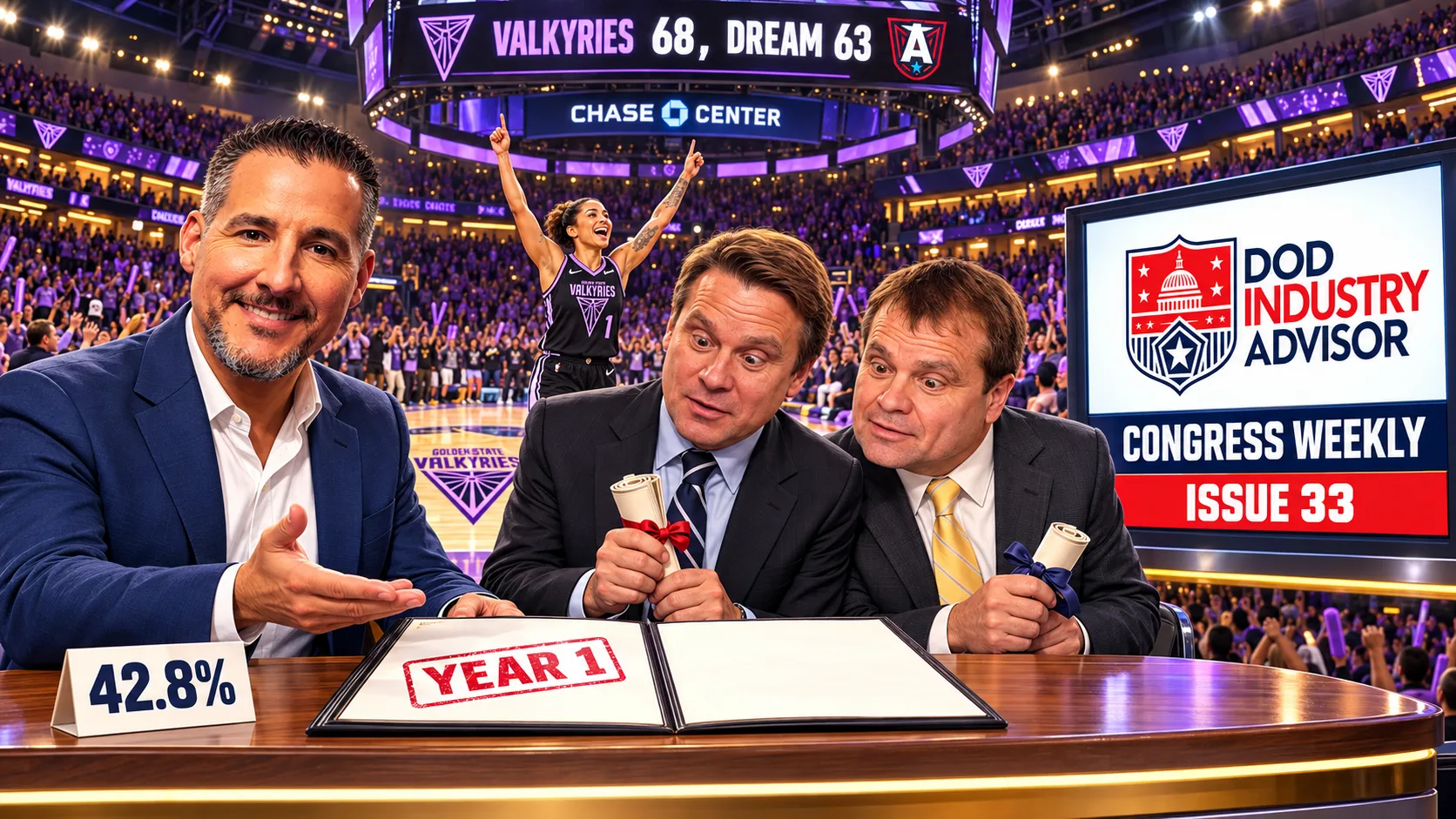
On Saturday night in San Francisco, Gabby Williams scored 30 points, 28 of them after halftime by ESPN’s count. The Golden State Valkyries beat the Atlanta Dream 68–63 in what ESPN calls the first Game 7 in WNBA Finals history. Golden State won the title in its second season. ESPN describes the roster as “an expansion club mostly made up of teams’ dispensable players.” Williams spent seven seasons in Chicago and Seattle, where she “mostly served as a role player.”
Second seasons are rarer in defense contracting. Fewer than half of the firms that win their first Pentagon contract get new money obligated to them the next year.
This winter the odds are worse for anyone new. The stopgap that funds the Department admits no expansion teams: it bars money for any program line that had none in fiscal 2026. Until Congress passes full-year bills, the second season is won inside programs that already had money last year.
42.8%. Of the roughly 5,260 firms that got their first Defense Department contract money in fiscal 2024, about 2,250 had new Defense money obligated to them in fiscal 2025. Every class from fiscal 2020 through fiscal 2024 landed between 41 and 46 percent.
The first contract is the tryout. The second year is the season most firms never get. DIA analysis of federal contract records. A second season here means a new obligation, not a payment, so a firm whose first award was funded in full up front can show none.
The Stopgap Has No Expansion Draft
The Department runs on a stopgap, P.L. 119-103, signed September 2. It continues fiscal 2026 rates until December 11, the deadline. Section 102(a) adds stricter terms for Defense alone. It allows no money to start producing an item that had no production money in fiscal 2026 or earlier, and none to raise production above fiscal 2026 rates. Nor may money go to any program element or line item “for which appropriations, funds, or other authority were not available during fiscal year 2026.” Call it the freeze. A program that had money last year keeps playing. One that did not cannot start.
The freeze lands hardest on young firms, because a second season tends to come from work already running. Of the new money the fiscal 2023 class won in fiscal 2024, about $2.6 billion came as new contracts and orders and $1.5 billion as changes to existing awards. Three in four of those new actions, carrying about half the money, were orders under contract vehicles that already existed. The records cannot say which first-year firms were waiting on a new program. They show where the second year usually comes from.
I carried the small-business account for the Pentagon’s acquisition office on Capitol Hill. Budgets are argued in totals and spent by line, and under the freeze the line is the whole game.
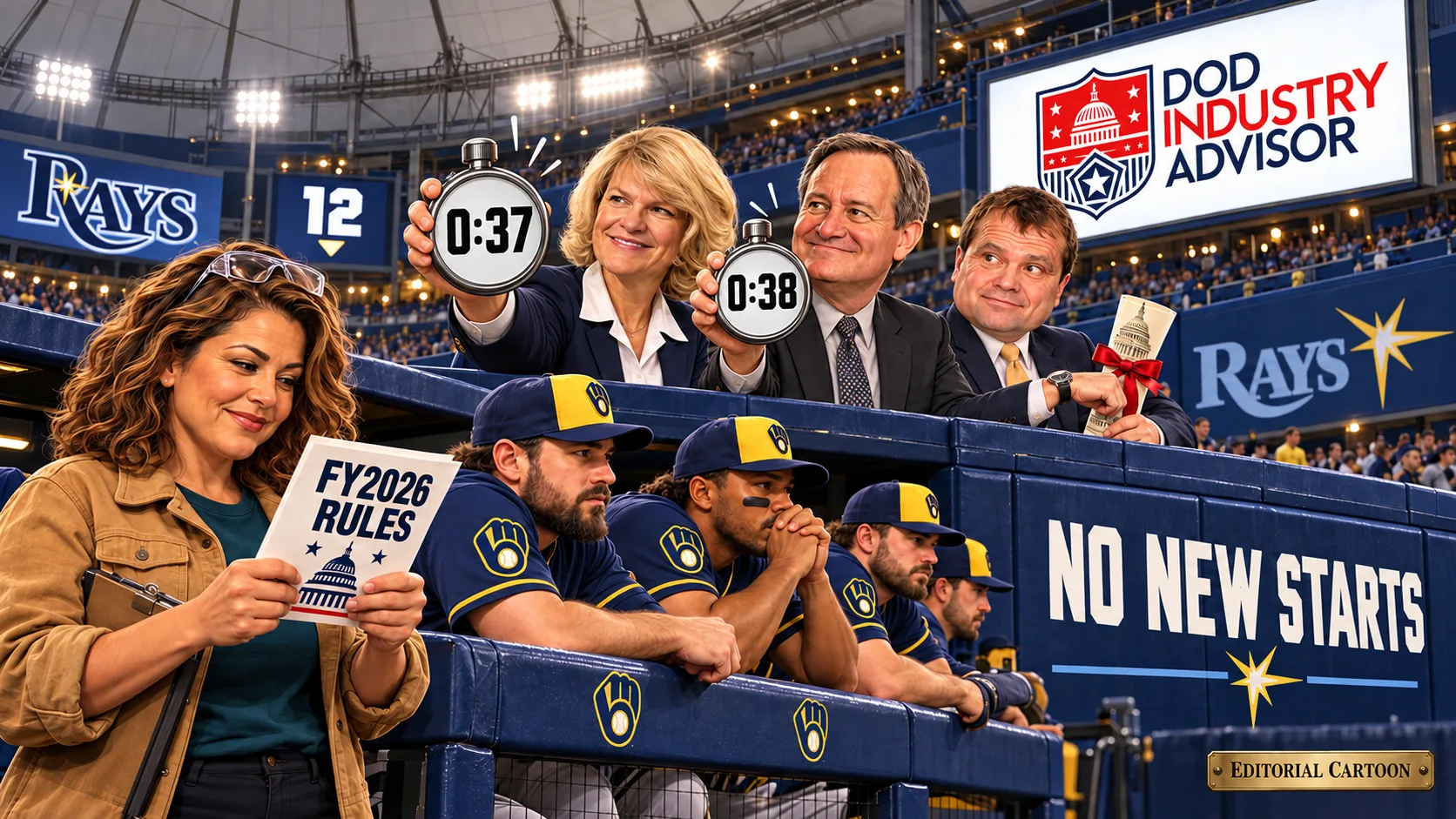
Fiscal 2027 Is in Extra Innings
Milwaukee lost Game 4 of the World Series on Tuesday at Tropicana Field. Cooper Pratt homered in the top of the 12th for a 3–2 lead, and Tampa Bay won 4–3 on two singles in the bottom half. The next night Jacob Misiorowski won Game 5, 4–1, and the Brewers were champions for the first time.
Fiscal 2027 began October 1 and is still being played on fiscal 2026’s rules. None of the twelve regular appropriations bills is law. The House Appropriations Committee reported the defense bill, H.R. 9495, on June 26, and it has not passed the House. This week each chamber met twice, pro forma, and nobody voted.
The strongest objection is that the Number is padded with one-time purchases. A single small order for parts is not a customer relationship. Take those out and the pattern holds. Of the 1,925 firms whose first year brought $100,000 or more, 55.7 percent got new money the next year. Bigger first awards do better, and more than four in ten of those firms still got none.
A full-year bill after the election would lift the freeze, and Congress may pass one. The record holds only a schedule and a date: Senate business on November 9 and the deadline 40 days from today. Milwaukee did not get Game 4 back. It won the next night with the roster it had. A firm planning its second year this winter has the same roster: the programs funded last year.
The Board
The middle column is what the record shows. The last column is the next thing you can observe.
| Item | What the record establishes | What to watch next |
|---|---|---|
| Funding | P.L. 119-103 holds fiscal 2026 rates through December 11; the freeze bars Defense new starts and production increases. | Full-year bills or a second stopgap |
| Fiscal 2027 bills | None of the twelve is law. The defense bill, reported June 26, has not passed the House. | A House floor vote on H.R. 9495 |
| Defense authorization | H.R. 8800 passed the House in July; received in the Senate September 14. | Senate floor action |
| House | Pro forma October 26 (2 min 36 s) and 29 (2 min 40 s). No roll call since September 16. | Pro forma November 2, 2:00 p.m., scheduled |
| Senate | Pro forma October 26 (37 s) and 29 (38 s). Last roll call September 30. | Business November 9; a 5:30 p.m. cloture vote on taking up H.R. 2347, scheduled |
| President’s desk | H.R. 8205 (ALS therapies; Rep. Quigley, D-Ill.) and H.R. 1744 (religious freedom commission; Rep. Smith, R-N.J.), presented October 26. | Ten days, Sundays excepted, run out November 6 |
| Contracting bill | H.R. 10948 (Rep. Van Orden, R-Wis.), introduced October 29, would extend the veterans’ employment emphasis in federal contracts to military spouses. | The bill’s text, not yet published |
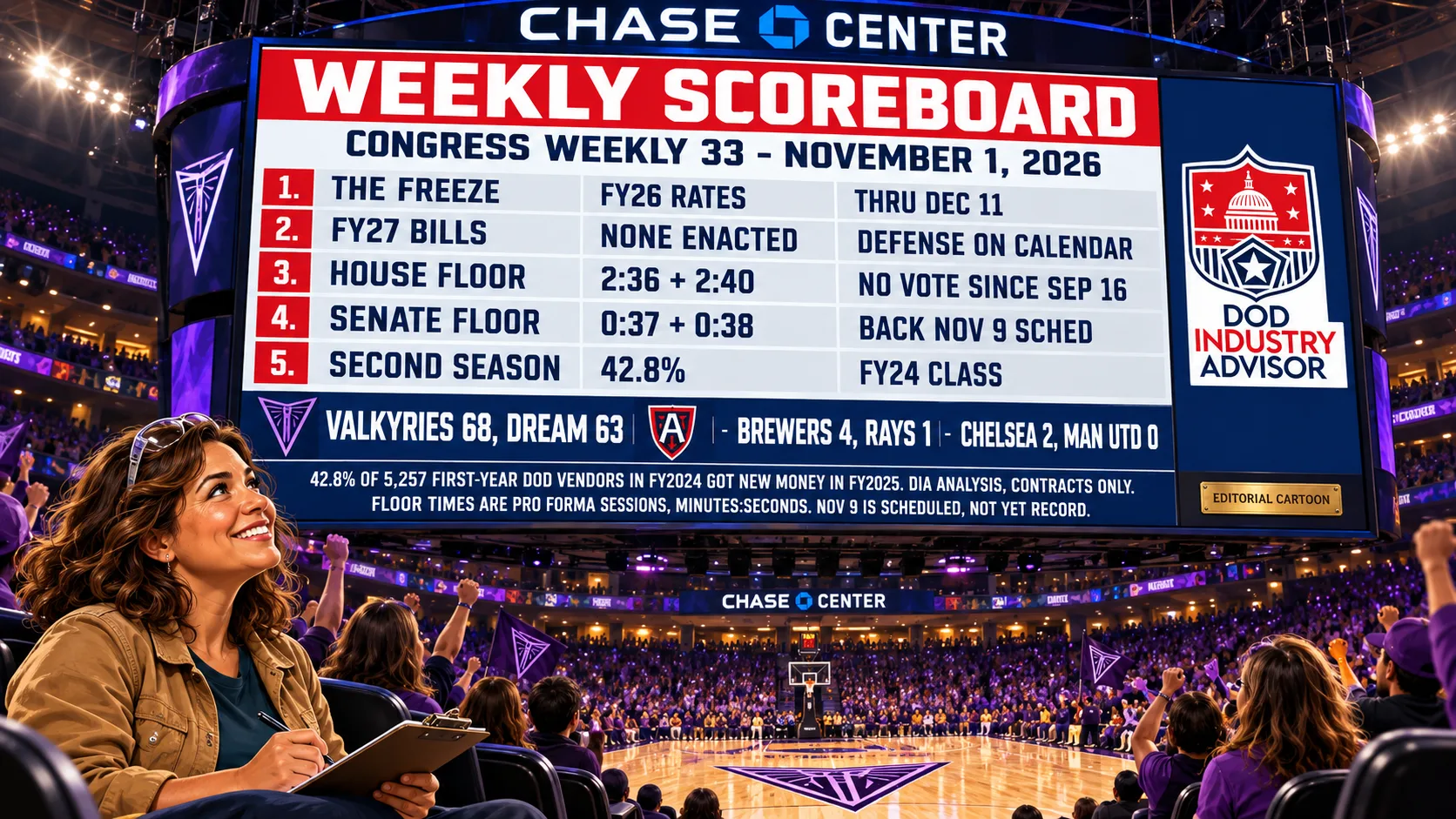
Both chambers are scheduled back November 9.
| Sun | Mon | Tue | Wed | Thu | Fri | Sat |
|---|---|---|---|---|---|---|
| Oct 25 | 26pro forma · both | 27 | 28 | 29pro forma · both | 30 | 31 |
| Nov 1today | 2pro forma sched. · both | 3Election Day | 4 | 5Senate pro forma sched. | 6 | 7 |
| 8 | 9Both, sched. · Senate 5:30 cloture vote | 10House sched. | 11House sched. | 12House sched. | 13 | 14 |
Navy: met pro forma, no business. Navy with a red bar: in session, on the record. Dashed: scheduled, not yet record. Red outline: today. Grey: not Congress. Blank: out. Past days come from the floor records; a schedule is a plan, not a record.
Playbook: Check Last Year’s Line
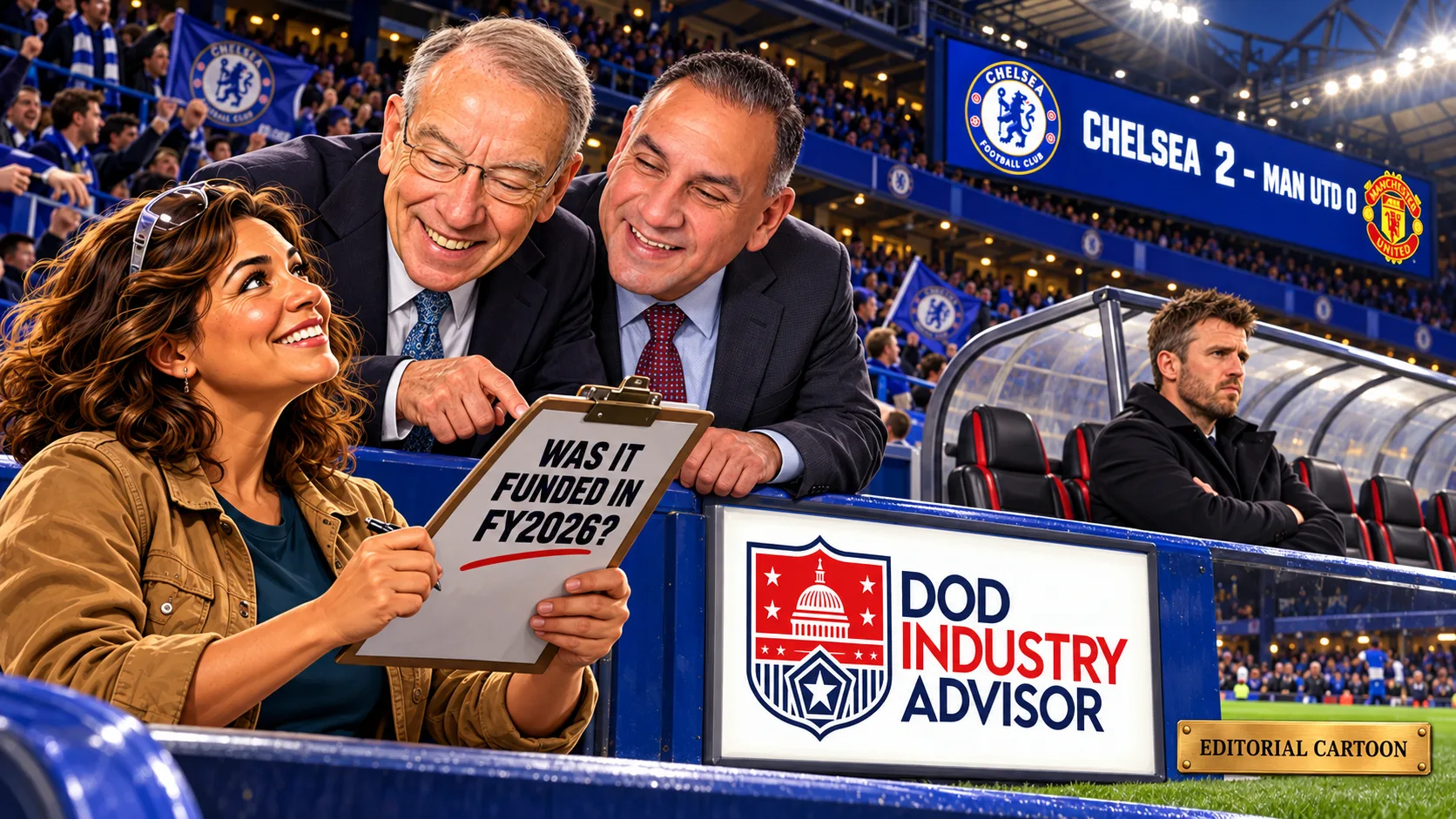
Manchester United lost 2–0 at Chelsea on Saturday. Lisandro Martínez was sent off in the 63rd minute, and Cole Palmer scored a penalty a minute later. United sit 17th, with 7 points from nine games. ESPN’s Mark Ogden writes that Michael Carrick “might be left to limp on as a lame-duck manager,” and calls United’s hierarchy “a committee with no obvious leader.” The Congress that returns after the election is a lame duck too. Until it decides, the Department keeps last year’s program list.
A funded line can keep playing. A new one waits.
The freeze sorts work by budget line. Research money is budgeted by program element, and procurement by line item; the statute names both. If the line that pays for an opportunity had fiscal 2026 money, work on it can continue at last year’s rate. If it had none, the work cannot start until Congress passes the year’s bill or writes an exception for it.
Consider a hypothetical nine-person firm that won its first Army order in fiscal 2026. It has two pursuits for fiscal 2027: a follow-on order on the same program, and a new prototype effort the Army has only announced. The follow-on sits on a line that had money last year. The prototype has no line in last year’s budget. This winter, only the follow-on can be funded.
List every fiscal 2027 opportunity in your pipeline. For each, write down the program element or line item that pays for it; the notice, the program office or the contracting officer can tell you. Mark whether that line had money in fiscal 2026. Put the ones that did at the top of this month’s work.
The Final Whistle
Gabby Williams spent seven seasons mostly as a role player before her 28-point second half in Game 7. Golden State won the title with the players it had. Expansion waits for Congress. This winter, the second season is won on last year’s lines.
Where did your second year of Defense money come from?
A) A new order from the same office
B) A change to my first award
C) A different buyer altogether
D) It has not come yet
E) Still working on the first
Reply with your letter and one line on why. The most useful answer runs next week, anonymous if you prefer.
How I Help Small Defense Businesses
Through DoD Industry Advisor I help small defense businesses turn market information into a pursuit decision: the buyer, the funding signals, the incumbent, the timing, the gaps in your position, and what to do next. Bring one opportunity you are weighing and the decision you need to make. Request a 30-minute fit call; we scope the work in writing before it starts. What DIA does.
Sources checked
CONFIRMED
- WNBA Finals: Game 7, Sat., Oct. 31, Chase Center, San Francisco: Golden State Valkyries 68, Atlanta Dream 63 (quarters GS 14-10-21-23, ATL 12-18-14-19). Gabby Williams (No. 1) 30 points in 38 minutes; Atlanta 6-of-30 from three. Golden State won the series 4–3; Game 5, Mon., Oct. 26, Valkyries 64–55; Game 6, Thu., Oct. 29, State Farm Arena, Dream 80–69. From ESPN’s reporting, attributed: the first Game 7 in WNBA Finals history; the Valkyries’ “first two seasons of their existence”; “an expansion club mostly made up of teams’ dispensable players and no top-tier free agents”; 28 of Williams’s 30 points in the second half; her first seven seasons with Chicago and Seattle, where she “mostly served as a role player.” Verified 2026-11-01. ESPN game page, Game 7 · ESPN, Alexa Philippou, Nov. 1 · ESPN, Kendra Andrews, Oct. 31
- World Series: Game 4, Tue., Oct. 27, Tropicana Field: Tampa Bay Rays 4, Milwaukee Brewers 3, 12 innings. Top of the 12th: Cooper Pratt homered (396 feet) for a 3–2 lead; bottom of the 12th: Jonny DeLuca singled in the tying run and Ben Williamson singled in the winning run. MLB’s uniform record for Game 4 lists Milwaukee, the road team, in the “Alt 2 Navy Blue Jersey,” “Road Grey Pants” and “Alt Yellow Front Hat.” Game 5, Wed., Oct. 28, Tropicana Field: Brewers 4, Rays 1; winning pitcher Jacob Misiorowski, losing pitcher Drew Rasmussen. Milwaukee won the series 4–1. ESPN: “For the first time, the Milwaukee Brewers are champions of the baseball world.” Verified 2026-11-01. ESPN game page, Game 4 · MLB uniform record, Game 4 · ESPN game page, Game 5 · ESPN, Bradford Doolittle
- Premier League: Sat., Oct. 31, Stamford Bridge: Chelsea 2, Manchester United 0. Morgan Rogers 50’; Lisandro Martínez (United) booked 59’, sent off on a second yellow 63’; Cole Palmer penalty 64’. Table after the match: United 17th, nine played, 1 win, 4 draws, 4 losses, 7 points. ESPN’s Mark Ogden, Oct. 31: “Carrick might be left to limp on as a lame-duck manager”; “the United hierarchy, a committee with no obvious leader.” Verified 2026-11-01. ESPN match page · ESPN table · ESPN, Mark Ogden
- P.L. 119-103 (H.R. 6500): Continuing Appropriations and Extensions Act, 2027, approved Sept. 2, 2026. Sec. 101 continues fiscal 2026 rates. Sec. 102(a), Defense: no funds for “(1) the new production of items not funded for production in fiscal year 2026 or prior years; (2) the increase in production rates above those sustained with fiscal year 2026 funds; or (3) the initiation, resumption, or continuation of any project, activity, operation, or organization (defined as any project, subproject, activity, budget activity, program element, and subprogram within a program element, and for any investment items defined as a P-1 line item … and an R-1 line item …) for which appropriations, funds, or other authority were not available during fiscal year 2026.” Sec. 106(3): available until Dec. 11, 2026. Verified 2026-11-01. govinfo, public law
- Fiscal 2027 appropriations: No regular fiscal 2027 appropriations act enacted; the only fiscal 2027 funding law in the 119th Congress’s public laws (through P.L. 119-136) is P.L. 119-103. H.R. 9495, Department of Defense Appropriations Act, 2027 (Rep. Calvert, R-Calif.): reported June 26, 2026 (H. Rept. 119-715), latest action “Placed on the Union Calendar, Calendar No. 621.” Verified 2026-11-01. congress.gov, H.R. 9495
- Defense authorization: H.R. 8800, National Defense Authorization Act for Fiscal Year 2027 (Rep. Rogers, R-Ala.): passed the House in July; latest action “Received in the Senate,” Sept. 14, 2026. Verified 2026-11-01. congress.gov, H.R. 8800
- House floor: Mon., Oct. 26, pro forma, convened 12:30:00 p.m., adjourned 12:32:36 p.m.; Thu., Oct. 29, pro forma, 12:00:00 to 12:02:40 p.m.; next meeting Nov. 2, 2:00 p.m. Last roll call No. 314, Sept. 16, 2026. Verified 2026-11-01. House Clerk floor log · House Clerk roll calls
- Senate floor: Daily Digest: Mon., Oct. 26, met 5:30:01 p.m. in pro forma session, adjourned 5:30:38 p.m.; Thu., Oct. 29, 2:00:01 to 2:00:39 p.m., adjourned until 4:30 p.m. Nov. 2. Every Senate day from Oct. 1 through Nov. 5 ordered pro forma with no business (Sept. 30 consent order, read 2026-11-01); on Nov. 9 the Senate convenes at 3:00 p.m. and cloture on the motion to proceed to H.R. 2347 ripens at 5:30 p.m. Last roll call vote 256, Sept. 30, 2026. Verified 2026-11-01. Congressional Record, Daily Digest · Sept. 30 order, S5299
- House schedule (a plan, not a record): the Majority Leader’s 2026 House Calendar, 119th Congress, Second Session (PDF updated Sept. 16, 2026), marks House session days Nov. 9, 10, 11 and 12, then Nov. 17–20 and Nov. 30. Scheduled, not yet record. Verified 2026-11-01. Majority Leader, 2026 House Calendar
- Bills presented: H.R. 8205 (Rep. Quigley, D-Ill.), Accelerating Access to Critical Therapies for ALS Reauthorization Act of 2026, and H.R. 1744 (Rep. Smith, R-N.J.), United States Commission on International Religious Freedom Reauthorization Act of 2026: latest action for both “Presented to President,” Oct. 26, 2026. Ten days, Sundays excepted, from Oct. 26 end Fri., Nov. 6 (computed). Verified 2026-11-01. H.R. 8205 · H.R. 1744
- H.R. 10948: Rep. Van Orden (R-Wis.), introduced Oct. 29, 2026: “To amend title 38, United States Code, to extend the veterans’ employment emphasis under Federal contracts to military spouses …”; referred to the Committee on Veterans’ Affairs. Title only; text not yet published. Verified 2026-11-01. congress.gov, H.R. 10948
- Election Day: Tue., Nov. 3, 2026, the Tuesday after the first Monday in November (2 U.S.C. 7). Verified 2026-11-01. 2 U.S.C. 7
- The Number, second seasons: DIA analysis of USAspending contract transactions awarded or funded by the Department of Defense (contracts only). A first-year vendor in fiscal year Y is a unique entity identifier with positive net obligations in Y and no record of any kind from FY2017 through Y−1; a second season is positive net obligations in Y+1. FY2024 class: 5,257 first-year vendors ($6.17 billion; median first year $52,500), of which 2,250 (42.8 percent) had positive net obligations in FY2025. Classes FY2020–FY2023: 41.2, 41.2, 45.1, 45.6 percent. By recipient name instead: 37.8 to 45.7 percent. FY2026 is not used (it thins after June 2026). Query
cw33_number.py, re-run 2026-11-01 against a database last modified Oct. 11, 2026. Verified 2026-11-01. USAspending - Where the second year came from: Same data and the same query file. Scope: the 2,317 FY2023-class vendors with positive net obligations in FY2024 (the class members that had a second season), all of their FY2024 Defense contract actions. A base action is one with modification number “0”; every other action is a modification; zero-dollar and negative actions are counted and netted. Base actions $2.626 billion over 30,399 actions; modifications $1.540 billion net over 7,234 actions. Of the base actions, 23,549 (77 percent by count; $1.304 billion, about half the dollars) carry a parent contract vehicle (IDV) number. Taken over the whole FY2023 class of 5,080 instead, the figures are $2.628 billion over 30,486 base actions, $1.510 billion over 8,129 modifications, and 23,564 orders; the rounded text holds either way. Verified 2026-11-01. USAspending
- First year of $100,000 or more: Same data. FY2024 class: 1,925 vendors, median first year $312,781, 55.7 percent with positive net obligations in FY2025 (FY2020–FY2023 classes: 56.8 to 62.4 percent). Verified 2026-11-01. USAspending
ASSESSMENT
- The freeze lands hardest on young firms. This is our reading of Sec. 102(a) and of where second-year money came from; the records do not show which first-year vendors depended on a new program.
- The vendor counts are firms, not measured small businesses: DIA’s copy carries no business-size field. The typical first-year obligation (about $50,000) suggests many are small.
- “Padded with one-time purchases” is the objection as we state it; the $100,000 test is our answer, not a measure of intent.
- Calling the post-election session a lame duck is the standard term; ESPN’s “lame-duck manager” is ESPN’s comparison, not a fact about the club, and nothing here forecasts what that session will pass.
- “I carried the small-business account for the Pentagon’s acquisition office on Capitol Hill” is the author’s own record, as stated on the DIA About page (Legislative Affairs representative to the OSD Acquisition and Sustainment portfolio). The second sentence of that paragraph is his judgement.
- The nine-person firm is hypothetical.
- Whether a given opportunity sits on a line with fiscal 2026 money is a question for its notice or program office; the Playbook’s rule is the statute’s, applied simply.
UNKNOWN — not found, not invented
- What the post-election session will pass, and when: no forecast made.
- The text of H.R. 10948: not yet published.
- Whether Manchester United will change managers: the club has said nothing in what was read.
- The House and Senate tallies on the defense authorization: not re-read this week, so not printed.
- Whether the Army’s MV-75 production award is held by Sec. 102(a)(1): reported by trade press from a company call; the company’s own filing was not read. Not used.
Source presentation is carried in the article body where applicable. Reported facts and analytic judgment are kept distinct.